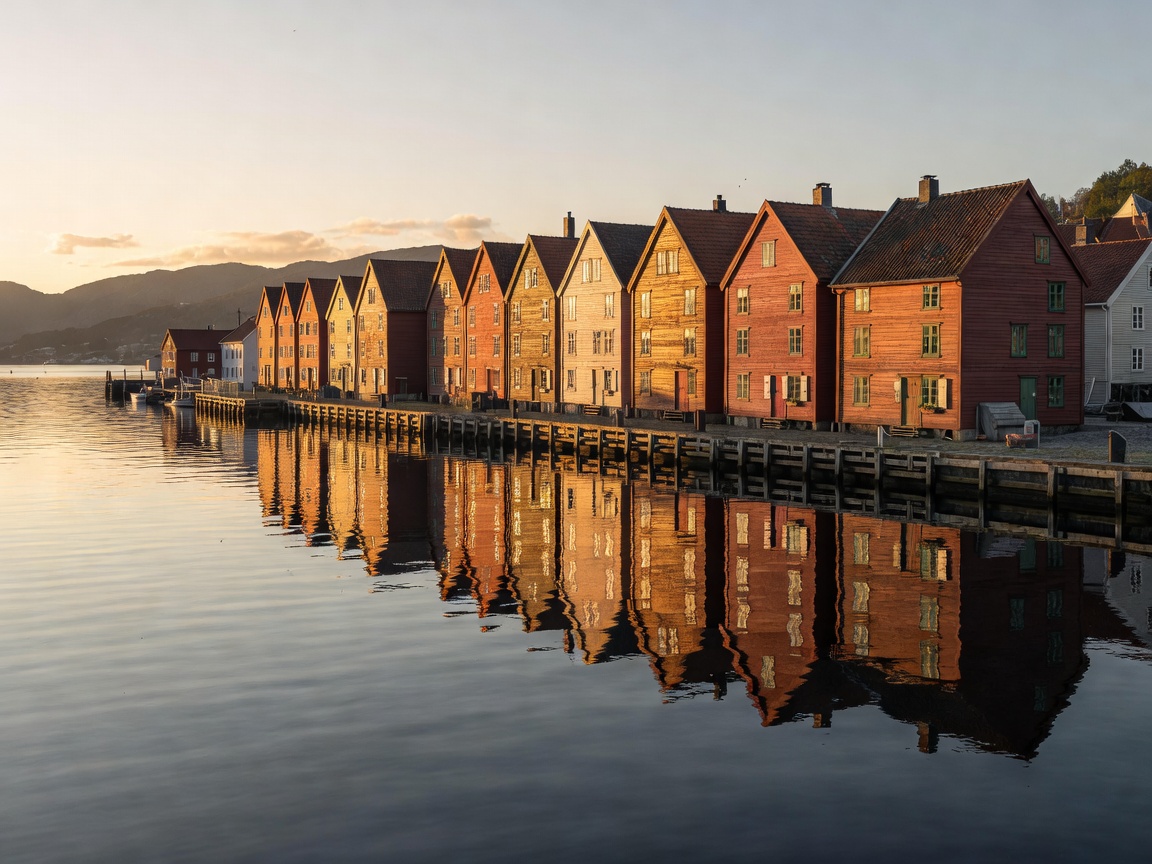
Bryggen: Medieval Guilds and Wood Preservation
Founded around 1070 CE by King Olav Kyrre, Bergen grew into one of the four principal foreign trading posts (Kontore) of the Hanseatic League from the 14th to the mid-16th century. The historic wharf district of Bryggen, inscribed as a UNESCO World Heritage site in 1979, remains a remarkably preserved timber trade complex. These long rows of gabled wooden warehouses served as offices, stockrooms, and dormitories for Hanseatic merchants trading dried stockfish (cod) from northern Norway for grain and salt from continental Europe.
Because Bryggen suffered numerous fires over its history—most notably in 1702—its survival is due to continuous rebuilding along exact medieval property lines. Today, the complex utilizes state-of-the-art groundwater monitoring and subterranean foundation stabilization to protect its wooden pilings from drying out and bacterial degradation.
Cultural Enclaves: KODE and Grieg’s Musical Legacy
Directly surrounding the central Lille Lungegårdsvann lake is KODE, one of Scandinavia’s largest collections of art, craft, and design. Spread across four main gallery buildings (KODE 1 through KODE 4), the institution houses the Rasmus Meyer collection, featuring essential works by Edvard Munch, J.C. Dahl, and Nikolai Astrup. KODE also administers the composer homes in the region, including Troldhaugen, the 19th-century villa and composer’s hut of Edvard Grieg situated on the shores of Lake Nordås.
The Mountain Interface: Fløibanen and Ulriken
Bergen’s geography is shaped by its mountainous amphitheater. The Fløibanen funicular, operating continuously since 1918, carries passengers from the downtown market square up to Mount Fløyen (320 meters above sea level) in approximately six minutes. From the summit, extensive gravel trail networks lead directly into the pine forests and upland lakes of the Byfjellene range. For higher alpine terrain, the Ulriken643 cable car reaches the highest peak of Mount Ulriken (643 meters), offering panoramic vistas across the archipelago and deep fjord valleys.
Maritime Food Traditions & Microclimate Logistics
Due to its proximity to the North Sea and North Atlantic Drift, Bergen maintains an oceanic climate characterized by temperate winters, mild summers, and substantial annual rainfall (averaging over 2,200 mm per year). This moisture nourishes lush coastal vegetation and fuels a culinary identity grounded in cold-water seafood. At the historic Fish Market (Fisketorget) and the neighborhood bistros of Nordnes and Sandviken, traditional Bergen fish soup (Bergensk fiskesuppe)—characterized by its velvety, slightly sweet and sour broth garnished with fresh haddock, pollock, and root vegetables—remains an enduring staple.
Neighborhood Overview: Bergen's Contrasting Districts
| District | Architectural Character | Notable Features | Terrain |
|---|---|---|---|
| Bryggen | 14th–18th century timber gables | Hanseatic Museum, narrow passages | Flat harbor level |
| Nordnes | 18th-century whitewashed cottages | Bergen Aquarium, seaside park | Narrow peninsula ridge |
| Sandviken | Timber boat-houses and stone steps | Norwegian Fisheries Museum | Steep hillside incline |
| Sentrum / Festplassen | Neoclassical & Art Nouveau stone | KODE galleries, Grieg Hall | Lakeside plain |
Transportation & Regional Connectivity
Bergen is linked to Oslo via the legendary Bergensbanen (Bergen Railway), an engineering feat spanning the high mountain plateau of Hardangervidda. Urban transit is managed by Skyss, incorporating a clean-energy light rail network (Bybanen) running seamlessly from Bergen Sentrum to Bergen Airport Flesland (BGO). Fast passenger catamarans depart daily from the Strandkaiterminalen to regional communities along the Sognefjord and Hardangerfjord.