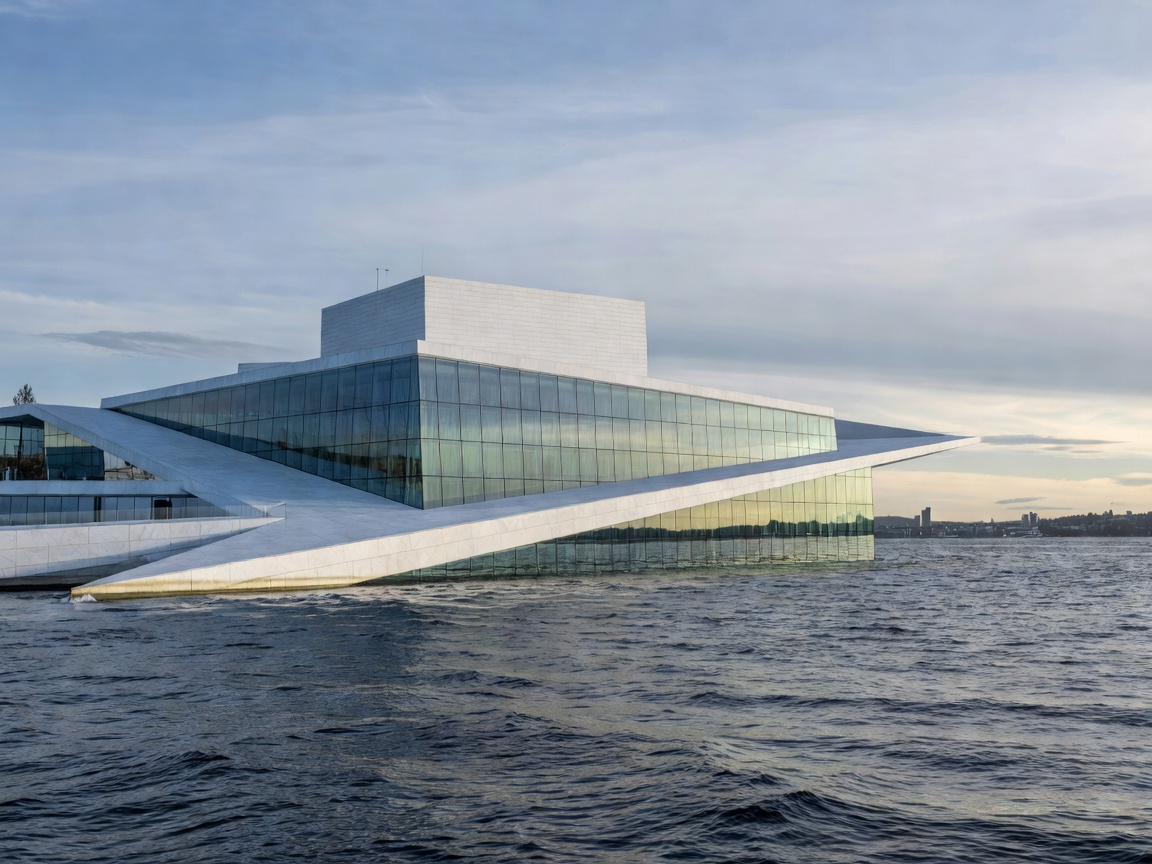
Civic Evolution and the Fjord City Masterplan
Over the last two decades, Oslo has undertaken one of Europe’s most ambitious post-industrial waterfront revivals, commonly known as the Fjordbyen (Fjord City) initiative. By redirecting container traffic and submerging multi-lane highway systems into underwater tunnels, the city reclaimed its direct relationship with the Oslofjord. The flagship precinct of Bjørvika stands as the focal point of this transformation, where high-density commercial developments like the Barcode Project meet cultural monoliths designed by world-renowned studios.
At the center of this waterfront corridor lies the Oslo Opera House, designed by Norwegian architectural firm Snøhetta. Completed in 2008, the structure features an angled roof paved with Italian Carrera marble and white granite that slopes directly into the seawater. This architectural gesture invites pedestrians to walk directly over the theater roof, effectively transforming private infrastructure into a public democratic square.
Museum Infrastructure: Munch, Nasjonalmuseet, and Bygdøy
In close proximity to the Opera House stands the MUNCH museum, designed by Spanish architect Juan Herreros. Reaching thirteen stories with an intentional forward slant clad in perforated, translucent aluminium sheets, the building houses the monumental bequest of Edvard Munch. Its vertical design concentrates exhibition galleries, conservation labs, and observation lounges within an energy-conscious footprint.
Further west along the harbor sits the new National Museum of Art, Architecture and Design (Nasjonalmuseet), which opened in 2022. Spanning over 54,000 square meters, it constitutes the largest art museum in the Nordic region. Clad in Norwegian slate with an illuminated translucent Light Hall on its upper tier, the facility reconciles medieval tapestries, modernist furniture, and Nordic romantic landscapes under a singular institutional roof.
Across the harbor on the forested Bygdøy peninsula, the heritage of Norwegian maritime exploration remains preserved. While the historic Viking Ship Museum undergoes major expansion into the Museum of the Viking Age, visitors still access the Fram Museum—housing the reinforced polar vessel that carried Fridtjof Nansen, Otto Sverdrup, and Roald Amundsen through Arctic pack ice—and the Kon-Tiki Museum, chronicling Thor Heyerdahl’s trans-oceanic expeditions.
Urban Neighborhoods: Grünerløkka, Frogner, and Tøyen
Beyond the marble harbor fronts, Oslo’s civic vitality is defined by its distinct residential districts:
- Grünerløkka: Situated along the Akerselva river, this former 19th-century working-class district has evolved into the city’s creative core. Independent roasteries, vintage bookstores, and micro-breweries occupy brick tenement buildings surrounding Olaf Ryes Plass and Birkelunden park.
- Frogner & Majorstuen: Characterized by wide tree-lined boulevards and late-19th-century neoclassical residential apartments, this western district is home to Vigeland Sculpture Park (Vigelandsparken), showcasing over 200 bronze, granite, and wrought-iron sculptures by Gustav Vigeland.
- Tøyen & Grønland: An ethnically diverse cultural hub east of the central station, offering spice markets, contemporary street art, the University Botanical Gardens, and burgeoning artist collectives.
Culinary Culture & Public Wellness
Oslo’s contemporary gastronomy emphasizes hyper-seasonal Nordic ingredients, wood-fired cooking, and sustainable aquaculture. Informal dining thrives at food halls like Mathallen in Vulkan and the waterfront shipping-container pavilion at Vippa. In parallel, public urban saunas operated by associations like the Oslo Sauna Association (Oslo Badstuforening) and KOK have proliferated along the harbor edge at Sørenga and Sukkerbiten, allowing citizens to alternate between wood-stove heat and direct fjord swimming year-round.
Comparative Overview: Oslo District Character
| District | Primary Architecture | Key Institutions | Vibe & Activity |
|---|---|---|---|
| Bjørvika | Contemporary glass, marble, slate | Opera House, MUNCH, Deichman Library | Harbor walks, saunas, modern art |
| Grünerløkka | 19th-century brick tenements | Akerselva cultural strip, Mathallen | Coffee culture, boutiques, river parks |
| Frogner | Neoclassical stone and stucco | Vigeland Park, Oslo City Museum | Diplomatic quarter, fine dining, green lawns |
| Bygdøy | Timber villas & nautical pavilions | Fram Museum, Kon-Tiki, Folk Museum | Biking trails, coastal beaches, maritime history |
Transportation & Practical Considerations
Oslo operates an entirely unified transit network managed by Ruter, integrating electric buses, trams (Trikk), the suburban metro (T-bane), and public harbor passenger ferries under a zone-based ticketing system. Visitors should note that the entire transit network is cashless; tickets must be obtained via mobile application or contactless terminal prior to boarding.